


E-commerce and the AGEC Act: what does this mean for you?
12 October 2022

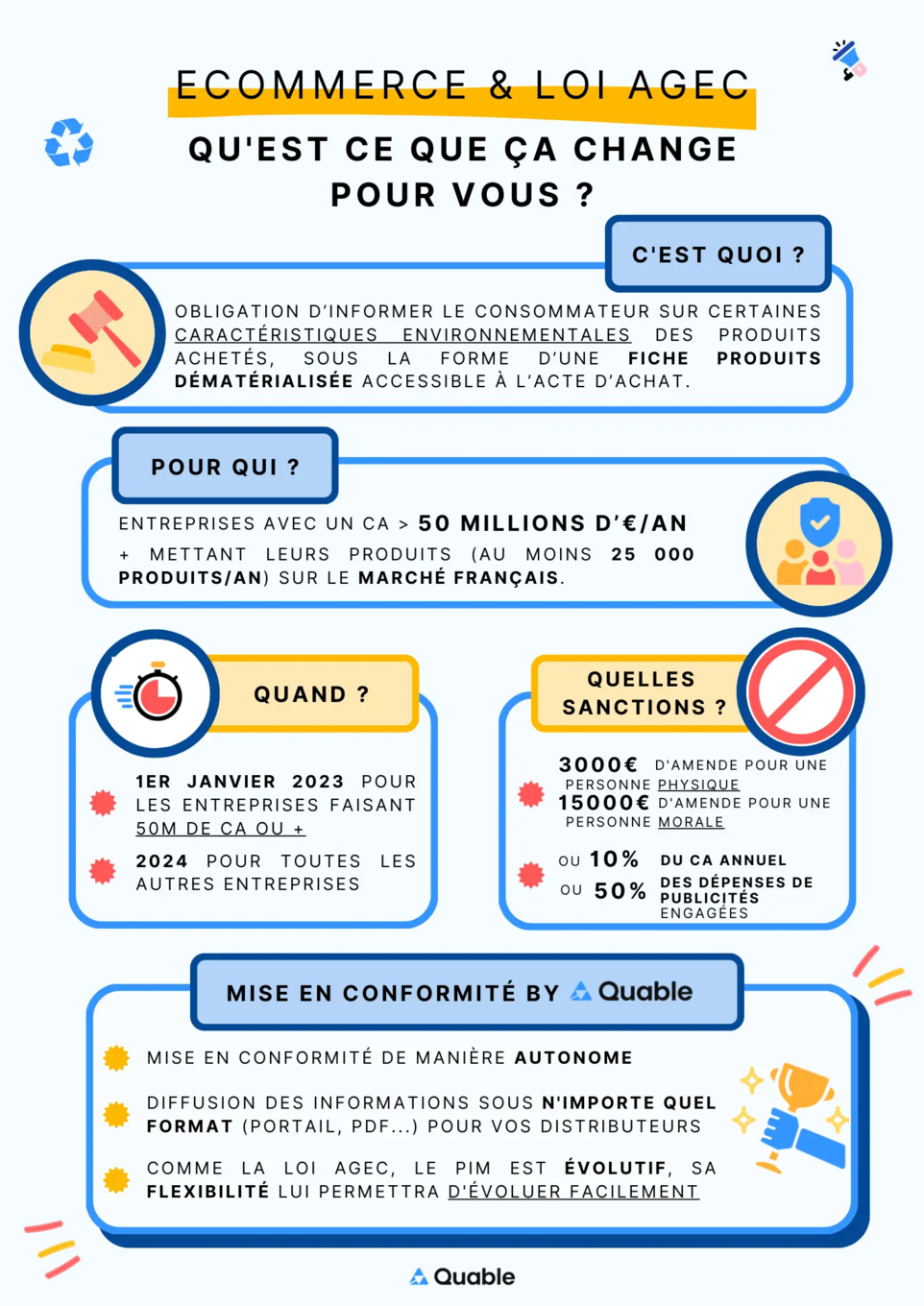
If you are an e-commerce retailer with an annual turnover of more than 50 million euros who sells your products (at least 25,000 products per year) on the French market, then you are affected by the implementation of this Act, which will come into force on 1 January 2023 – very soon, in fact. However, there’s no need to worry: we’ll explain everything you need to know about this Act and how to comply quickly.
What is the Agec Act and what does it entail?
With a view to transparency and better communication with consumers, the Agec Act aims to make it compulsory to inform consumers about certain environmental characteristics of the products they purchase. It also aims to combat waste, improve production methods and extend extended producer responsibility. This information must be provided in the form of a digital product information sheet accessible at the point of purchase. This whole approach forms part of a broader framework: today, any company placing a product on the market can no longer ignore its end-of-life phase, for which it is responsible.
Which organisations are affected, and for what types of goods?
- Textiles, household linen and footwear,
- Electrical and electronic equipment,
- Household, industrial and commercial packaging,
- Paper,
- Furnishings,
- Toys,
- Sports and leisure goods.
Please note: if your annual turnover is less than 50 million euros, you will only be exempt until 1 January 2024, when this law will apply to all businesses, regardless of turnover.
What information must be provided to buyers?
Everything is set out in detail in the official decree accompanying this law.
However, the information and the way in which it must be displayed differ depending on the sectors concerned:
- For electronic equipment: the presence of precious metals and rare earth elements must be displayed as follows: “Contains X milligrams of silver”, for example.
- For clothing: the geographical indication of the country where certain stages of manufacture, such as weaving or tailoring, take place must be stated as a note.
All products covered by a digital product information sheet, and the information that must be included, are listed here.

What are the consequences of failing to comply with the law?
If a company fails to comply with the provisions of the AGEC Act, this is deemed to be a misleading commercial practice, punishable by a fine of 3,000 euros for a natural person and 15,000 euros for a legal entity.
Furthermore, the penalty may also amount to 10 per cent of annual turnover or 50 per cent of advertising expenditure incurred, in accordance with the Consumer Code. Finally, the rate may be increased to up to 80 per cent of the advertising expenditure incurred if the so-called misleading claims relate to the environmental impact of the goods or services being sold.
How will the PIM help you achieve compliance?
Good news: all the features you need to comply with this new law are already included in the PIM! If you’re already using the Quable PIM, you can carry out this compliance process entirely on your own; by adding fields (or attributes), bulk-updating information, managing it (using completeness checks, tags and validation processes) and publishing it via your usual channels.
Put simply, the PIM is the ideal tool, enabling you to enter this new, now mandatory information and distribute it however you wish (via a portal, PDF, etc.), ensuring that the information is made available.

For your distributors, retailers and marketplaces, it couldn’t be simpler: you’ll be able to respond quickly and easily to their requests by providing them with the relevant information in any format.
The focus on consumer information will be strengthened over time (from January 2024, for example, the repairability index will have to be included); here too, the flexibility of the PIM is the right solution, as it is scalable.
Conclusion
The coming into force of this law marks a real turning point in terms of recycling, reuse, responsible and sustainable consumption, and the fight against waste, all in the interests of a more sustainable economy. It also marks a real turning point for you, as an e-retailer, to ensure you comply with the standards in the event of any inspection.
Although the PIM is perfectly capable of meeting these new requirements for transparency and communication with your current and future customers, whether online or in your physical shops, we advise you to consult your legal department regarding the Agec Act.
Would you like to ensure compliance with the Agec Act?
You can also view the Agec Act infographic, which summarises everything you need to know about this new legislation and how best to prepare for it: